


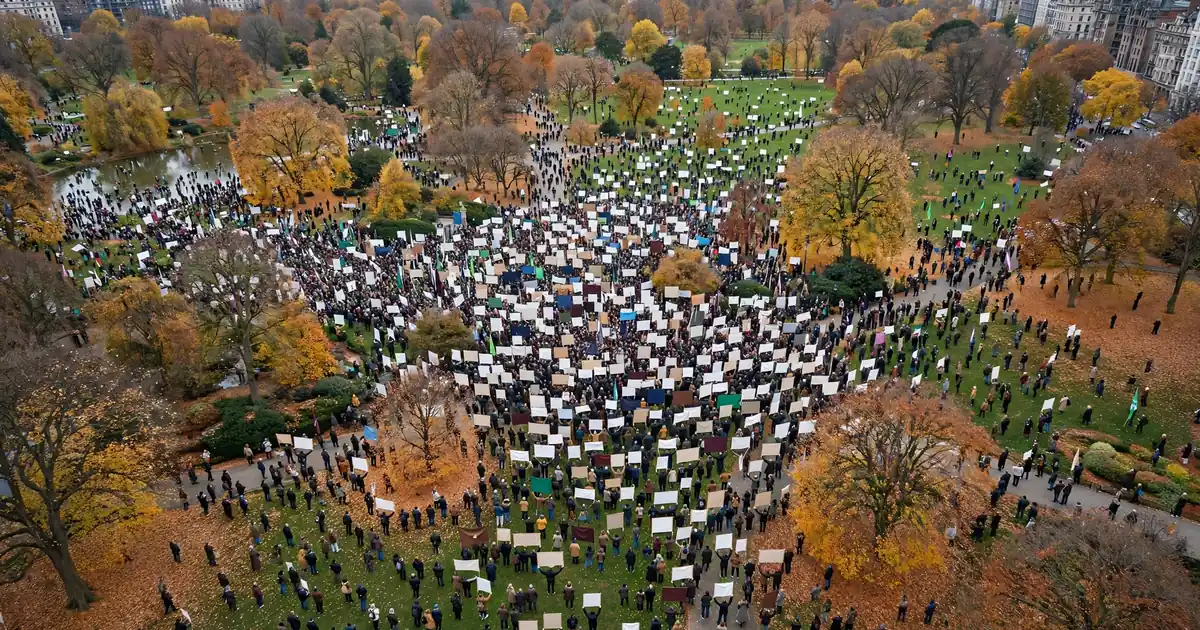
On a sunny Sunday afternoon in Prague, the crowd kept coming. By the time the speeches started, Letna park was full and the metro stations below were clogged with people. Organisers put the number at between 350,000 and 450,000 — potentially the biggest demonstration in the Czech Republic since the Velvet Revolution of 1989.
They had come for one reason: a bill that would change how Czech public television and radio are paid for. Prime Minister Andrej Babis wants to scrap the monthly fee every household pays and fund the broadcasters from the state budget instead, plus a 15 percent cut. The crowd called it a threat to the independence of the news they trust, not a technical change.
What the government wants to change
Czech households currently pay a monthly broadcasting fee of 205 crowns, about $9.26, which funds Czech Television and Czech Radio directly. The money does not pass through the government. That is the point of it: the broadcasters answer to the people who pay, not to the politicians of the day.
The government’s draft bill would cancel that fee and replace it with money from the state budget. The bill has already passed a preliminary vote in parliament and is waiting for further debate. It got there in a hurry. The ruling coalition moved it through the lower house on 24 October, limiting the opposition’s speaking time before voting at 4:36 in the morning to push it through the first of three parliamentary readings. Opposition parties and civic groups have been furious about the timing ever since, calling on the coalition to withdraw the law altogether.
The change would come with a cut. The proposed 15 percent reduction in financing would push Czech Television’s nominal budget back to its 2008 level and Czech Radio’s back to 2005. The broadcasters say that is unworkable. Running a national television service on a budget from nearly twenty years ago, while everything it does has got more expensive, is not a saving. It is a slow strangulation.
A crowd that kept growing
The rally was organised by Milion Chvilek — A Million Moments — the civic group that has led some of the largest protests in the country’s recent history. Its chairman, Mikulas Minar, estimated that around 400,000 people turned out. Even the lower end of the organisers’ range, 350,000, would dwarf the anti-government protest of more than 200,000 people in March, which the Sunday crowd had already passed by the afternoon.
The scale was visible in the small details. Nearby metro stations filled with people carrying Czech flags. Protesters held signs reading “Hands off the media” and “Let media deal with politicians”. Speakers on the stage included students, soldiers, and former dissidents who signed Charter 77, the human rights manifesto that helped define the opposition to Communist rule. And scattered through the crowd were people wearing pointed hats folded out of newspaper — a tribute to the animated character who has introduced Czech Television’s nightly children’s bedtime stories for decades. It was a gentle joke, and a pointed one: this was a protest about an institution people had grown up with.
Milana Rudolfova, a 72-year-old pensioner in the crowd, told Reuters why she had come. “I know that our entire Czech Television is a guarantee of truth and objectivity,” she said. “If we do not have public television and radio then unfortunately we will not be able to believe anything anymore.”
That sentiment ran through the whole afternoon. For many of the people there, Czech Television and Czech Radio are not just channels. They are the places they turn when they want to know what is actually happening, and they do not trust anyone else to do the job.
Why critics call this a fight for independence
The argument against the bill is simple, and it is about who holds the purse strings. A broadcaster funded by a fee paid by households has a direct relationship with its audience. A broadcaster funded from the state budget has a relationship with the government that writes that budget. Critics say that shift would leave Czech Television and Czech Radio exposed to political pressure every time the budget is set — and that a government which already accuses the media of bias would not hesitate to use it.
Minar put it bluntly from the stage. “An elected government has the right to govern but it does not have the right to do whatever it wants and to dismantle democratic institutions,” he said. Then he issued the government a challenge: “Show that your aim is not to take control of them and let experts propose genuine safeguards for their independence from political power.”
The comparison most often made by critics is with Hungary, where former Prime Minister Viktor Orban built up an array of pro-government media while independent outlets were squeezed. Nobody in Prague is claiming the Czech Republic is Hungary. The point of the comparison is that it shows how it starts: not with a ban, but with a funding change, a budget cut, and a slow shift in who the media answers to.
The dispute has already travelled beyond the Czech Republic. Media freedom and the rule of law in the country were debated in the European Parliament the week before the rally, and the reform has drawn international attention precisely because it is happening inside the European Union, where press freedom is supposed to be settled law.
The government’s case
Babis and his government see it very differently. The prime minister, a billionaire who returned to power after his ANO movement won last year’s election, says the plan is simply about easing the burden on households. Scrapping a monthly fee that every home has to pay is, in his telling, a promise kept to voters, not an attack on the press. He has vowed to press ahead with the plan despite the protests and denies it poses any threat to media freedom.
His coalition partners have been blunter. The government, backed by the far-right SPD — Freedom and Direct Democracy, an anti-migrant and pro-Russian party — and the eurosceptic Motorists, accuses Czech private and public media of bias. That accusation is the other half of the argument: the government says the broadcasters are not the neutral institutions their defenders claim, and that a system where they are funded by the state is fairer and more modern.
It is a familiar pattern in European politics. Governments that clash with the press often frame the fight as one about money and fairness, while their critics frame it as one about control. Both sides in Prague are doing exactly that. The question is which story the Czech public believes, and on Sunday, several hundred thousand of them gave their answer in person.
Two days before an anniversary
The timing of the rally was not an accident. It took place two days before 17 November, the public holiday that marks the start of the Velvet Revolution — the protests of 1989 that ended more than forty years of Communist rule and brought the dissident playwright Vaclav Havel to power. Letna park itself carries that history: huge crowds gathered there during the revolution, and the organisers said Sunday’s turnout could end up as the largest demonstration since those days.
The echoes of 1989 were deliberate. The speakers included the Charter 77 dissidents. The crowd’s newspaper hats nodded to a shared childhood. And the date itself did the rest of the work — a reminder, two days early, of what mass protest in this country has achieved before.
This was not the first time the media had fought back, either. Earlier in November, staff at Czech Television and Czech Radio staged a one-day strike that disrupted broadcasts, with protests backed by artists and students. Thousands had already rallied across the country that day. Sunday’s demonstration in Prague was the movement growing louder, not starting from scratch.
What happens next
The bill is not law yet. It has passed its first reading, but two more readings remain, and the opposition — along with the crowds — is demanding it be withdrawn. Babis has given no sign of backing down. He says the government will keep its promise to scrap the fee, and his coalition holds the votes to push the bill forward if it chooses to.
What happens in parliament over the coming weeks will decide whether the protest changes anything. The organisers want the bill withdrawn, a genuine public debate, and real guarantees for the broadcasters’ independence. The government wants the fee gone and the funding moved to the state budget. There is not much middle ground between those two positions.
For now, the numbers from Sunday are the story. No official crowd count was published — the figures come from the organisers — but even the most cautious reading puts the turnout in the hundreds of thousands, in a country of fewer than 11 million people. That is a lot of Czechs, on a Sunday afternoon, telling their government to leave the news alone.
Conclusion
Sunday’s rally was about a fee, a budget line, and a bill most people had never heard of a month ago. It became something bigger because of what those things represent: whether the country’s public broadcasters answer to the people who pay for them, or to the government that writes the cheques. Babis says it is about easing the burden on households. The crowds in Letna park say it is about who controls the news. With two parliamentary readings to come, that argument is far from over — but after 15 November, the government knows how many people are watching.
FAQs
Why are people protesting in Prague?
Hundreds of thousands rallied on 15 November 2026 against a government bill that would scrap the 205-crown monthly public broadcasting fee and fund Czech Television and Czech Radio from the state budget instead, with a 15 percent funding cut. Critics say the change would threaten the broadcasters’ independence.
How many people attended the Prague protest?
Organisers from the civic group Milion Chvilek (A Million Moments) estimated between 350,000 and 450,000 people, with chairman Mikulas Minar estimating around 400,000. No official crowd count was published. It was described as potentially the largest Czech demonstration since the Velvet Revolution in 1989.
What is the 205-crown broadcasting fee?
It is the monthly household fee — 205 Czech crowns, about $9.26 — that currently funds Czech Television and Czech Radio directly, without the money passing through the government. The government’s bill would cancel it.
What would the 15 percent cut mean for Czech TV and radio?
The proposed cut would reduce Czech Television’s nominal budget to its 2008 level and Czech Radio’s to its 2005 level. The broadcasters say that is unworkable.
What was the Velvet Revolution?
The Velvet Revolution was the wave of protests in November 1989 that ended more than forty years of Communist rule in Czechoslovakia and brought dissident playwright Vaclav Havel to power. Its anniversary is marked on 17 November, two days after the Prague rally.
More on Vision24:
News · Business
Sources:
Reuters · Associated Press (The Week) · Associated Press (CNA) · AFP

2 Comments
Pingback: COP31 Draft Deal: Shocking $120 Billion Plan to End Fossil Fuels
Pingback: Xi Trump Putin Summit: Historic First Meeting of 3 Nuclear Powers