


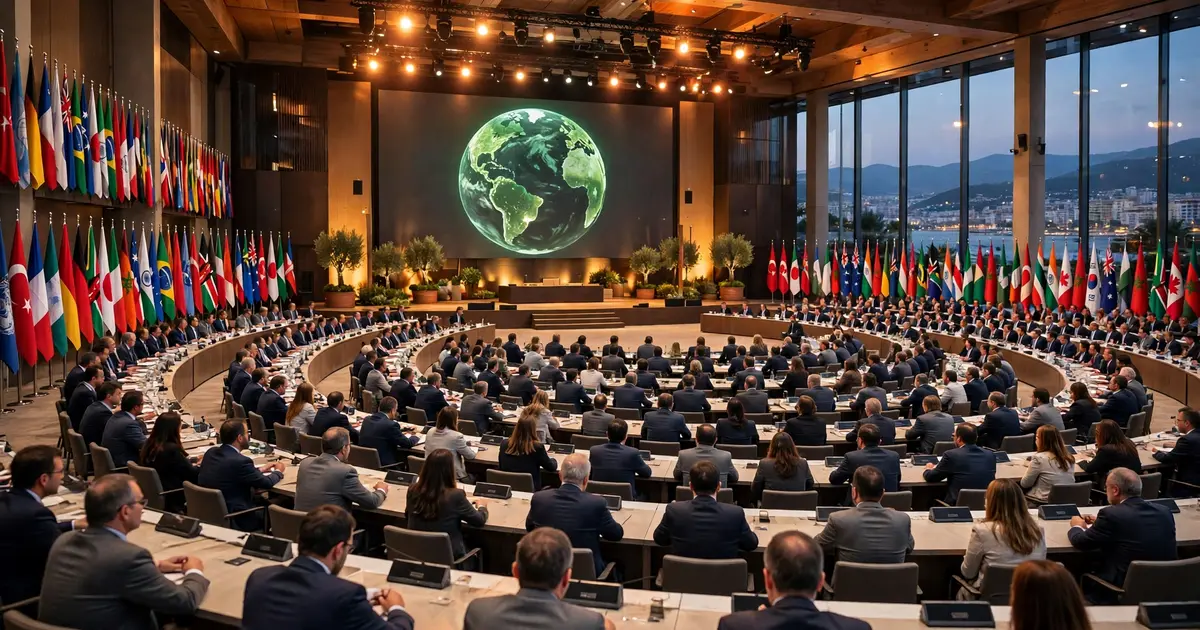
The COP31 draft deal arrived in Antalya on Monday with a message that surprised even seasoned climate watchers: phase out fossil fuels faster, and triple the money that helps poorer countries survive a hotter world. The 18-page draft, published by the COP31 presidency at the start of the summit’s second week, is the first version of the cover decision — the political document that will define what nearly 200 countries agree to when the talks close on Friday, 20 November. It is not final, and much of it may not survive the week. But as a statement of intent, the COP31 draft deal is the boldest climate text the world has seen in years.
What the COP31 Draft Deal Actually Says
A cover decision sits above all the technical negotiations at a climate summit. It is the headline document — the paragraphs that news reports quote when the talks end. The COP31 draft deal runs to 144 separate items, drawn from submissions by more than 160 countries and over 500 pages of feedback. Australia’s climate minister Chris Bowen, who is leading the negotiations, released it in Antalya on Monday and was blunt about its status: “This is a draft, a first draft. It won’t be the final draft.” He added that it was designed to test what countries could accept, not to record only the points they already agree on. That honesty matters, because the COP31 draft deal contains language that several major countries will fight hard to remove before Friday.
The draft’s headline provision calls for “accelerated action to phase out fossil fuels, including through the immediate transition away from fossil fuels in energy systems”. That wording is stronger than what countries agreed at COP28 in Dubai in 2023, when they committed only to “transitioning away” from fossil fuels. The COP31 draft deal also calls for phasing out inefficient fossil fuel subsidies that do not tackle energy poverty or support a just transition, and it welcomes Brazil’s voluntary fossil fuel transition roadmap as a model other countries could follow.
The $120 Billion Question: Who Pays for Adaptation?
The biggest number in the COP31 draft deal is $120 billion. The draft proposes tripling finance for climate adaptation in developing countries to at least $120 billion a year by 2035, and it asks developed countries to produce a roadmap with milestones showing how they will get there. Adaptation finance is the money that pays for flood defences, drought-resistant crops, early warning systems and the other measures that help countries live with climate change that is already happening.
The context makes the figure look both ambitious and inadequate at the same time. According to the UN Environment Programme’s 2026 Adaptation Gap Report, which the draft itself cites, developing countries will need about $305 billion a year by 2035. International public adaptation finance stood at only $28 billion to $32 billion in 2024. Even tripling that would cover no more than 29 per cent of estimated needs. The COP31 draft deal also asks the Standing Committee on Finance to calculate a baseline for the tripling target using Oxfam’s grant-equivalent methodology, with countries set to consider that baseline at COP32 in 2027. It further proposes an Antalya-to-Addis Ababa roadmap to identify predictable public funding for adaptation and for loss and damage, and it calls on developed countries to announce pledges by the end of 2027 to funds including the Adaptation Fund and the Fund for Responding to Loss and Damage.
The demand did not come from nowhere. At COP30 in Belém, Brazil, countries agreed on the need to triple adaptation finance by 2035. The issue goes back further still: at COP26 in Glasgow, developed countries were urged to at least double their collective adaptation finance from 2019 levels by 2025. The COP31 draft deal is the first text to put a specific dollar figure and a delivery mechanism on that promise.
Fossil Fuels: The Fight at the Heart of the Text
The fossil fuel language is where the COP31 draft deal will face its hardest test. The draft carries two rival wordings on the issue: one repeating the 2023 pledge to transition away from fossil fuels, and a stronger clause calling for their phase-out. Either could still be dropped from the final deal. Russia, Saudi Arabia and the Arab group have objected to having a cover decision at all, even though such decisions have featured in most of the 30 previous climate summits. Australia’s Bowen, who chairs the formal negotiations, has refused to commit his own country — one of the world’s biggest coal producers — to phasing out fossil fuel exports, arguing that exporters do not carry more responsibility than importers.
The draft also proposes bringing forward the target for developed nations to reach net zero by 2030 and net-negative emissions by 2040 — earlier than many existing commitments. And it pushes an electrification goal championed by Türkiye, the COP31 host: raising electricity’s share of final energy demand from the current 23 per cent to 35 per cent by 2035. India has already declined to sign that pledge, citing grid affordability and the European Union’s carbon border tax. With about 30 negotiating items still to settle this week and 48 already agreed, the fossil fuel paragraphs are the ones ministers will argue over longest.
The 1.5°C Target: Already Out of Reach?
Perhaps the most sobering part of the COP31 draft deal is what it says about the 1.5°C target — the central goal of the 2015 Paris Agreement. The draft expresses deep concern at the scientific finding that global warming is projected to exceed 1.5°C above pre-industrial levels, and it calls for temperatures to return below that threshold “as early as possible within this century”. A scientific assessment published by the UN Environment Programme earlier this year said warming of 1.7 to 1.8°C was now inevitable, meaning the 1.5°C limit can no longer be held without a period of overshoot.
The COP31 draft deal responds by proposing a new technical work programme on understanding the science of 1.5°C, with a particular focus on pathways to return to that level at some point. It also calls for the next assessment reports from the Intergovernmental Panel on Climate Change to be ready in time for the 2028 global stocktake — the next full review of how the world is doing against the Paris Agreement. The language is careful, but its meaning is plain: the summit’s own draft admits the world has already failed to keep warming within 1.5°C, and the argument now is about how far beyond it temperatures will go and for how long.
What It Means for Pakistan and Developing Countries
For Pakistan, the COP31 draft deal is not an abstract diplomatic exercise. The country is among the most climate-vulnerable in the world, and the 2022 floods — which caused more than $30 billion in damage — remain a fresh memory. Adaptation finance is the part of the climate talks that matters most to countries like Pakistan: money for flood protection, resilient infrastructure and early warning systems, delivered as grants rather than loans that add to already heavy debt.
The draft’s $120 billion figure, if it survives, would be a real step forward. But the gap between $120 billion and the $305 billion that developing countries actually need shows how far the talks still have to go. Climate campaigners have already warned that the money must actually arrive, not just be promised. Mohamed Adow, director of Power Shift Africa, welcomed the inclusion of the $120 billion proposal but warned that the final agreement must ensure the money is delivered. That concern is sharpened by analysis from Carbon Brief showing that public funding pledged to help developing countries address climate change had fallen by more than 70 per cent in 2026.
What the Critics Are Saying
Not everyone is impressed by the COP31 draft deal. Climate campaign group 350.org said the draft acknowledged the need to move away from fossil fuels but dropped any clear process to advance transition roadmaps, leaving the pledge without a way forward. The group also warned that even tripling adaptation finance to $120 billion a year would remain well below the more than $420 billion developing countries need. Ministers began responding to the draft on Tuesday, and at least one more version is expected before the talks close on Friday. Bowen himself has said the final version will be shorter than the 18-page draft — a sign that many of its 144 items will be cut, merged or dropped entirely in the final days of negotiation.
What Happens Next in Antalya
The COP31 draft deal now enters its hardest phase. Ministers from nearly 200 nations are in Antalya negotiating the text directly, and the summit is scheduled to conclude on Friday, 20 November. Any part of the draft without consensus will be dropped. The fossil fuel language, the $120 billion finance target and the 2030 net-zero call for developed nations are all on the chopping block. What survives will tell the world how serious governments are about the promises they made in Paris more than a decade ago — and how much they are willing to pay to keep them.
FAQs
What is a cover decision at COP31?
A cover decision is the summit’s overall political declaration. It sits above the technical negotiations and sets out the main messages all countries agree on — the paragraphs that headlines quote when the talks end. The COP31 draft deal is the first version of that document.
When does COP31 end?
COP31 in Antalya, Türkiye, is scheduled to conclude on Friday, 20 November 2026. The first draft of the cover decision was released on Monday, 16 November, and at least one more version is expected before the final deal is adopted.
What is adaptation finance?
Adaptation finance is money that helps countries cope with climate change that is already happening — flood defences, drought-resistant crops, early warning systems and resilient infrastructure. The COP31 draft deal proposes tripling it to at least $120 billion a year by 2035.
Will the COP31 draft deal become the final agreement?
Not as it stands. Australia’s Chris Bowen, who is leading the negotiations, has said plainly that the draft “won’t be the final draft”. Any part without consensus will be dropped, and the final version is expected to be shorter.
Conclusion
The COP31 draft deal is a bold opening bid, not a finished agreement. Its call to phase out fossil fuels faster, its $120 billion adaptation finance target and its honest admission that the 1.5°C limit has slipped out of reach make it the most ambitious climate text in years. But drafts do not cut emissions or build flood defences — only final deals do. What survives the negotiations in Antalya this week will show whether governments are ready to turn strong words into real money and real action.

2 Comments
Pingback: Bitcoin Below $65,000: Shocking 26% Crash Explained
Pingback: Xi Trump Putin Summit: Historic First Meeting of 3 Nuclear Powers