


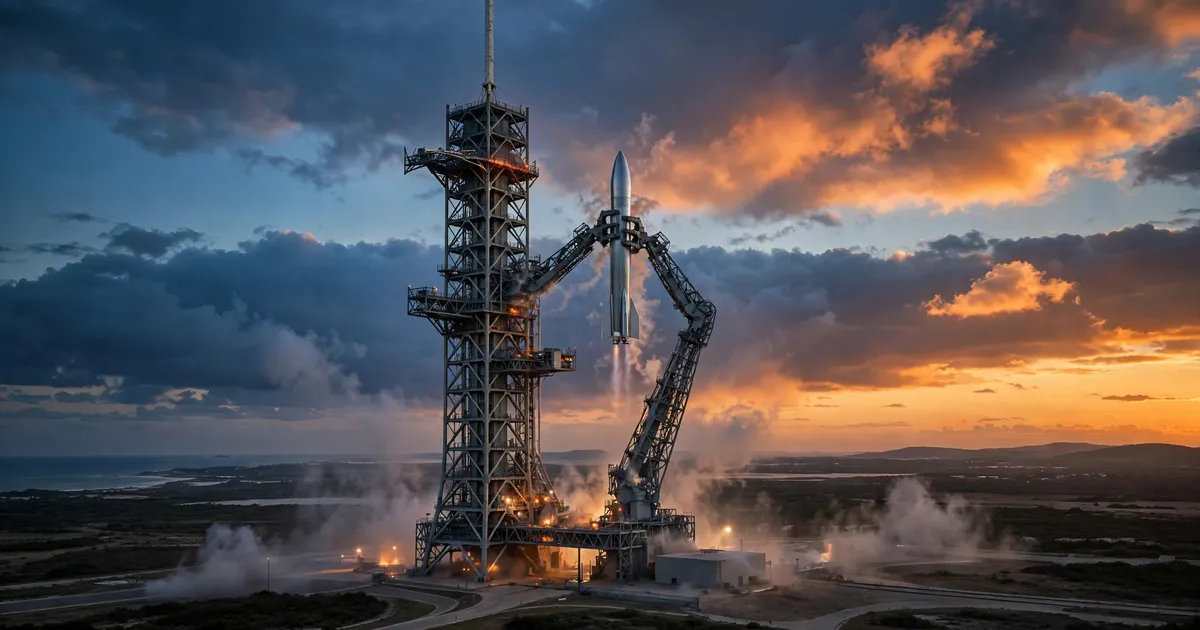
On Saturday afternoon in South Texas, a rocket the size of a fifteen-storey building fell out of the sky, fired its engines, and came to a stop between two steel arms on the same tower it had launched from a day earlier. SpaceX had just done something no one had ever done before: it caught a spacecraft returning from orbit.
The vehicle was Ship 42, the upper stage of the company’s Starship rocket. It had spent about 22 hours in orbit, circled the Earth 14 times, and dropped off 26 new Starlink satellites before turning for home. At around 4:20 in the afternoon Eastern time, the tower’s two mechanical arms — the “chopsticks”, nicknamed Mechazilla — closed around it at Starbase, SpaceX’s launch site in Texas. The catch capped off Starship’s fifteenth test flight, and it was the first time an upper stage returning from orbit had been plucked out of the air at its launch site.
It was not a perfect flight. The Super Heavy booster that had carried Ship 42 into space never made it back. Its return burn ended early, the onboard system called off the catch, and it was lost over the Gulf of Mexico. SpaceX got the headline it wanted and a problem to solve, both on the same day.
The catch
SpaceX has been catching rockets with the tower arms for a while now, but only ever the booster — the big first stage that lifts the rocket off the pad and comes back a few minutes later. The tower had caught a Super Heavy three times before, most recently in March 2025. The upper stage, the part that actually goes to orbit, had never been caught. Flight 15 was the first attempt.
Ship 42 came home the hard way. After nearly a full day in space, it fired its engines to leave orbit and flew back to Starbase, descending through overcast skies over Boca Chica. It lit its engines for the final landing burn, flipped itself upright in the manoeuvre SpaceX calls a belly flop, and slid between the waiting arms at Launch Pad 2. The arms swung shut around it. The engines cut out. The ship stopped, hanging in the tower’s grip.
“Mechazilla has caught Starship,” the SpaceX commentator said on the live broadcast, “we have waited a long time to say that.”
That is the honest version of the story. SpaceX has been talking about catching the ship for years, and the company has lost several of them along the way — in the ocean, in pieces, in fireballs over the Caribbean. This time the arms held.
Twenty-two hours in orbit
The flight itself began on Friday evening, 13 November, when Flight 15 lifted off from Starbase at 22:47 UTC. All 33 engines on the Super Heavy booster fired, pushing Ship 42 and its booster towards orbit before the two vehicles separated.
Once in orbit, Ship 42 did the job the flight was partly built around: it deployed 26 Starlink V3 satellites, the next generation of SpaceX’s internet constellation. It then stayed up there, circling the Earth 14 times at an altitude of roughly 265 kilometres, for about 22 hours — the longest Starship flight so far.
That long stay in orbit mattered. Earlier Starship flights were short hops by comparison, up and down in under an hour. A full day in orbit, with a satellite deployment in the middle of it, is much closer to what the rocket is actually for. Starship is meant to carry satellites, cargo, and eventually people, and none of that works if the ship cannot spend real time in space and come home afterwards. On Saturday it did both.
The booster that didn’t come back
The plan had been to catch both stages. SpaceX has now caught the booster before, so a double catch — booster and ship, same flight — was the thing everyone was watching for. It did not happen.
The Super Heavy booster, Booster 22, was supposed to return to Starbase about six and a half minutes after liftoff. Instead its return burn ended early, the automated system decided a tower catch was no longer safe, and the booster was diverted away from land. It was lost over the Gulf of Mexico.
SpaceX is still investigating what went wrong. Elon Musk said on Saturday that the booster had suffered a slight underperformance of its engines, which is why it was sent offshore instead of back to the tower. The details will come out in the investigation, but the outline is already clear: the ship’s catch was a first, the booster’s loss was a reminder that this rocket is still being tested, and the two halves of the story belong together.
It is worth being precise about this. Some of the early coverage called Flight 15 a double catch. It was not. One stage came home to the tower. The other is at the bottom of the Gulf.
Why the catch matters
Catching the ship matters for a simple reason: it is the only way Starship works as a business. The whole point of the rocket is that both stages come back, get checked over, and fly again quickly — like an aeroplane, not like a firework. Throwing the ship away after every flight would make Starship just another very large, very expensive rocket. Catching it is what makes it different.
That is also why the tower exists at all. There are no landing legs on Starship and no runway at Starbase. The plan has always been to grab the vehicle out of the air and set it straight back on the launch mount, ready to fly again. Doing that with a booster is one thing. Doing it with a ship that has just spent a day in orbit, survived re-entry, and is coming in at speed is another. On Saturday, SpaceX showed the second half of that plan works.
None of this means Starship is finished. The catch proves the ship can come home. It does not prove it can be turned around quickly and flown again, which is the part of the plan that has not been tested yet. A caught ship still has to be inspected, refuelled, and stacked on a booster before it flies again, and nobody knows how long that will take the first time it is tried. The real prize, as SpaceX’s own engineers would tell you, is not the catch. It is the second flight.
What happens next
SpaceX will spend the coming weeks on two things. The first is the booster investigation — finding out exactly why Booster 22’s return burn ended early, and what has to change before the next flight. The second is Ship 42 itself, which now has to be taken down from the tower and inspected, to see what a day in orbit and a catch did to it.
The company has not said when Flight 16 will fly. That is normal; the gap between Starship flights has always depended on what the last one taught them. Flight 15 taught them a lot. It taught them the ship can be caught, and it taught them the booster still has a failure mode they do not fully understand. Both lessons will shape the next flight.
For the space industry, the catch changes the conversation. Reusing a booster was already routine. Reusing an orbital spacecraft — catching it, rather than fishing it out of the sea — was the part that sounded like science fiction. On Saturday afternoon in Texas, it happened, in front of the cameras, in about thirty seconds.
FAQs
When did Starship Flight 15 launch?
Flight 15 lifted off from Starbase, Texas, on Friday 13 November 2026 at 22:47 UTC.
How was Ship 42 caught?
The tower’s two mechanical arms, known as chopsticks and nicknamed Mechazilla, closed around the ship as it descended to Launch Pad 2 on Saturday 14 November at about 4:20 p.m. Eastern time.
What happened to the booster?
Booster 22 did not return. Its return burn ended early, the automated system called off the catch, and it was lost over the Gulf of Mexico. SpaceX is investigating.
How long did Ship 42 spend in orbit?
About 22 hours, completing 14 orbits and deploying 26 Starlink V3 satellites.
Why does the catch matter?
It is a key step towards a fully reusable Starship. If both stages can be caught and reflown quickly, the cost of reaching orbit falls sharply.
Conclusion
Starship Flight 15 gave SpaceX the result it has been chasing for years: Ship 42 spent 22 hours in orbit, deployed 26 satellites, and came home to be caught by the tower’s arms at Starbase — the first time an orbital upper stage has ever been recovered that way. The loss of Booster 22 over the Gulf of Mexico keeps the flight from being a clean success, and the investigation into its failed return will shape what happens next. But the catch itself is real, and it brings the goal of a fully reusable Starship measurably closer.
Table of Contents
More on Vision24:
Tech · News · Business
Sources:
EarthSky · Scientific American

3 Comments
Pingback: GTA 6 Release Date, Price, Map, Characters & Gameplay: Full Guide
Pingback: Galaxy S28 Variable Aperture: Amazing Camera Comeback After 9 Years
Pingback: How AI Is Changing Work: 7 Amazing Shifts in 2026